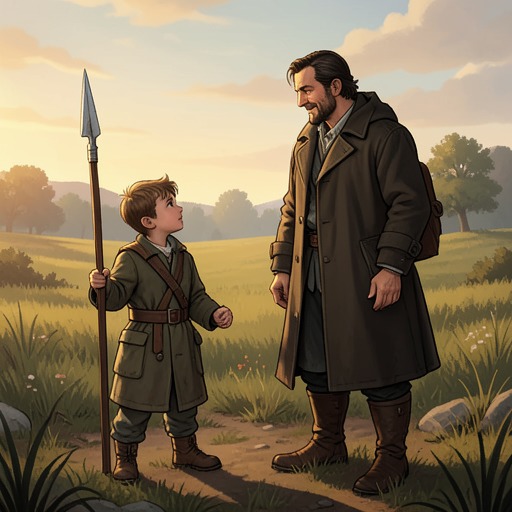
A decent man has boots on his feet
The Drover's Wife“A decent man has boots on his feet” is a repeated expression whose meaning changes as it passes between Danny, Yadaka, and Molly. First offered as a rule Danny has learned from his father, it becomes a challenge to judge character by conduct rather than appearance; later, when Molly offers Yadaka her murdered husband’s boots, it takes on the practical force of disguise. The phrase’s movement from a boy’s inherited ideal to an uneasy survival tactic makes footwear a measure not only of respectability but of the stories and identities people are made to wear.
Danny’s inherited rule
Danny tells Yadaka that his father reckons a decent man has boots on his feet. The saying is bound to a particular hope: Danny is supposed to get his father’s boots that winter, though he expects to have to chock one heel. The boots are already marked by the body that wore them, including Joe’s badly bowed left leg, which Danny imitates as he explains its history. In Danny’s account, the footwear promises a version of manhood and respectability, even as its broken fit carries the trace of injury and family hardship.
The exchange turns when Yadaka asks what the saying makes of the two of them. They look at their dirty, bare feet and share a smile. Yadaka does not simply dismiss Danny’s belief; he revises its measure, telling him that decency depends not on what a person wears but on how he carries himself. The distinction matters because Danny has just shown him a scar from his father’s belt and tried to excuse the violence by saying Joe was drunk and did silly things. Yadaka recognizes the violence in the story but does not press the boy further. His response offers Danny a different standard of decency without forcing him to defend his father.
From maxim to material disguise
The expression returns in a changed form when Molly sees Yadaka wearing Joe’s old clothes. She jokes that a pair of boots could make him pass for a decent man, then supplies an explanation he can use if anyone questions him: he worked for her and was paid in old clothes. The lie is built from a truth, and the boots would complete its appearance. What once sounded like a moral rule is now a way to manage how a fugitive is seen in a hostile world.
Molly’s offer carries a cost and a history. She has buried Joe beneath the old woodheap, with his boots beside him; the mound is a shallow grave covered with stacked wood, and dogs have tried to dig there. She tells Yadaka he may take the boots because wearing them might draw less attention if he is stopped, and advises him to use Joe’s white name. The footwear is thus not an abstract emblem: it belongs to the dead man whose violence Molly has concealed, and its possible use by Yadaka would turn that intimate evidence into protection. Yadaka refuses the boots, leaving the proposal unresolved rather than accepting the disguise.
A story carried in bodies
The novel’s later return to the saying’s concerns is not another exchange about footwear but a repeated story enacted through movement. Danny’s account of the wild grey bullock becomes the Story of the Bullock: Yadaka first joins Danny’s telling by mimicking the animal in an Aboriginal dance, stamping and flicking dirt as Danny describes the danger to his family. The story travels beyond that encounter. Danny tells it to the Ngarigo, who incorporate it into cultural practice through mimicry, dance, song, and movement.
For Danny and his siblings, the Ngarigo’s performance honours Molly’s bravery and acknowledges her plight; by adopting the story, the clan brings her into its family. The children are proud to see men, women, and children dressed and painted to perform it. In the later family scene, Danny’s own children make a simpler version without paint, singing, or traditional instruments. His daughter takes the pretend gun, while Danny removes his shirt to show his people’s markings and imitates the bullock as Yadaka once did. When the child shouts and acts out the shot, Danny falls, and the children tumble onto him as his wife laughs and praises them in her mother tongue.
What the expression comes to mean
The boots saying links an inherited ideal of male respectability to the realities that undermine it: a father’s violence, a concealed grave, and the threat of being recognized or stopped. Its repeated appearance also makes meaning depend on who is speaking and what the situation demands. Danny’s father supplies the rule; Yadaka redirects it toward conduct; Molly turns its image of the booted man into a possible cover for escape. The same object can signify a hoped-for inheritance, a history of abuse, or a means of avoiding scrutiny.
The wider pattern of the Bullock story gives the expression an additional resonance without making it a literal refrain. What lasts is not a fixed definition of decency but the capacity to carry a family’s history forward, revising it through attention, performance, and shared memory. The boots remain with Joe when Yadaka refuses them; the story, by contrast, passes from Danny to Yadaka’s dance, from the Ngarigo community to Danny’s children, and into a continuing family practice. In that contrast, the novel measures inheritance less by what can be worn than by what people choose to remember and pass on.